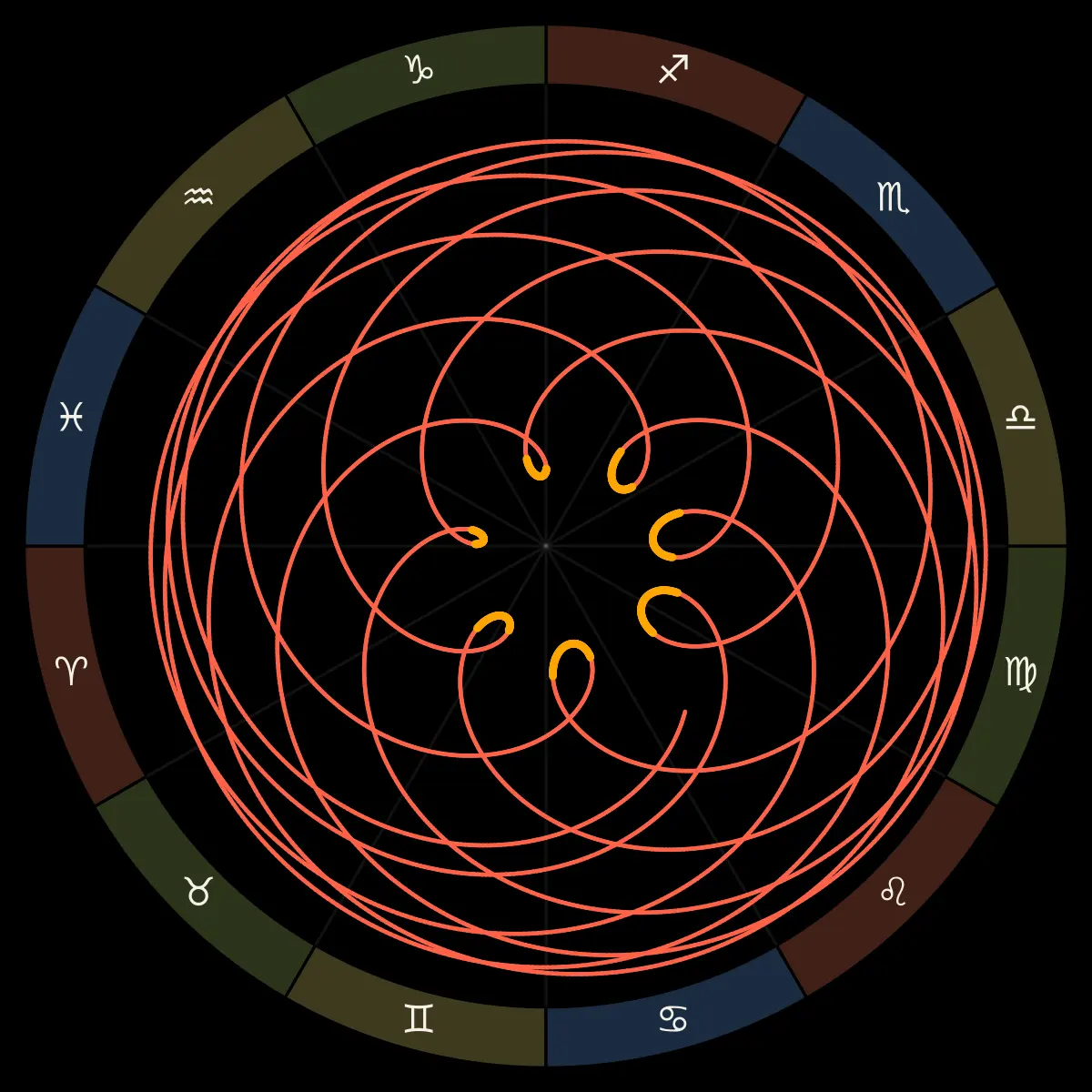
♂ Mars’s cycles
Mars comes back to the same place against the Sun about every 780 days, a little over two years. It rises out of the Sun’s glare in the dawn sky and climbs higher each morning. As the Earth comes round to overtake it, Mars slows, stops and runs backwards for two to two and a half months—a retrograde—and in the middle of it stands opposite the Sun: up all night, at its closest and brightest. Then it turns forward again and sinks slowly into the evening twilight to meet the Sun and begin again.
Why it runs backward
The retrograde is a trick of perspective—but unlike Mercury and Venus, it’s the Earth doing the overtaking. On our smaller, faster orbit we catch Mars up and pass it, and for those weeks it seems to slide backwards against the stars.
Around the zodiac
Mars comes back to the same part of the sky about every 15 years, 13–31° further back.
| 1990 | ♊︎ 5° | ♋︎ 17° | ♌︎ 22° | ♍︎ 26° | ♏︎ 4° | ♐︎ 22° | ♓︎ 5° |
|---|---|---|---|---|---|---|---|
| 2005 | ♉︎ 15° | ♋︎ 2° | ♌︎ 9° | ♍︎ 13° | ♎︎ 18° | ♐︎ 1° | ♒︎ 4° |
| 2020 | ♈︎ 21° | ♊︎ 16° | ♋︎ 26° | ♍︎ 0° | ♎︎ 4° | ♏︎ 13° | ♑︎ 6° |
| 2035 | ♓︎ 22° | ♉︎ 27° | ♋︎ 11° | ♌︎ 17° | ♍︎ 21° | ♎︎ 27° | ♐︎ 13° |
| 2050 | ♒︎ 21° | ♉︎ 5° | ♊︎ 26° | ♌︎ 4° | ♍︎ 8° | ♎︎ 13° | ♏︎ 24° |